


Let us have an honest bedside chat. When our culture talks about menopause, the conversation usually focuses on hot flashes, night sweats, and mood changes. What almost nobody prepares you for until you sit on an exam table is the significant vaginal dryness and discomfort that develops below the belt.
Suddenly, everyday underwear feels irritating against delicate skin. Routine trips out of the house turn into anxious searches for the nearest restroom, and sex after menopause becomes unexpectedly uncomfortable. To make matters worse, many women begin experiencing painful sex after menopause alongside frequent urinary tract infections for the first time in their lives.
If this sounds familiar, take a deep breath. Your body is not broken, and you did not do anything wrong. You are experiencing Genitourinary Syndrome of Menopause, clinically known as GSM. According to clinical data published by The Menopause Society, this condition impacts approximately 50% to 70% of postmenopausal women, making it one of the most common and treatable midlife health concerns.
What Causes the Down-There Drought?
Estrogen maintains the thickness, elasticity, and natural moisture of your pelvic tissues. It supports the lining of the vagina, vulva, bladder, and urethra, keeping those tissues cushioned and naturally acidic.
When estrogen levels decline during and after menopause, that tissue foundation changes rapidly. Without adequate estrogen, the body undergoes several distinct physiological shifts that directly explain what causes vaginal dryness, tissue irritation, and pelvic floor changes.
Thinning Tissues and Everyday Discomfort
First, the vaginal walls lose their natural elastic folds, known as rugae. Without estrogen to rebuild them, that resilient tissue cushion thins from up to thirty cellular layers down to just three or four delicate layers.
The blood vessels that support natural tissue moisture also decrease. In this fragile state, routine friction from walking, exercise, snug clothing, or intimacy easily causes burning irritation and micro-tears.
At the same time, the natural transudate lubrication produced during arousal decreases significantly. Even when desire and emotional connection are fully present, the physical tissue cannot respond without proper clinical support.
The Microbiome Shift: Why UTIs Increase After 50
Second, a biological shift occurs inside your vaginal microbiome. Estrogen supports beneficial bacteria called Lactobacilli, which produce lactic acid to keep your vaginal pH acidic, ideally between 3.8 and 4.5.
When estrogen levels drop, that protective acid barrier weakens and vaginal pH frequently rises to 5.5 or higher. In this alkaline environment, protective Lactobacilli die off, and digestive tract bacteria such as uropathogenic E. coli can colonize the area and migrate directly into the urethra.
Epidemiological studies indicate that recurrent urinary tract infections occur in more than 10% of postmenopausal women, with the incidence rising further after age 65. This rise in infections represents a clear biological barrier failure rather than an issue with personal hygiene.
Why GSM Does Not Resolve on Its Own
Here is an essential clinical reality: while vasomotor symptoms like hot flashes and night sweats resolve on their own after an average of seven years, GSM is progressive. Without targeted local therapy, it does not improve over time.
Left unmanaged, tissue thinning continues, elasticity decreases further, and chronic pelvic discomfort can become persistent.
Despite this high prevalence, large-scale studies such as the REVIVE survey revealed that less than 10% of symptomatic women actively initiate conversations about vaginal dryness with their healthcare provider. Many assume pain during sex and bladder urgency are simply unavoidable parts of aging, yet advocating for your reproductive health means recognizing that no woman needs to tolerate preventable physical discomfort.
Reducing Daily Irritation and Chafing
Vulvar skin is delicate and absorbs topical products quickly. The first step in finding relief is eliminating common daily irritants from your personal care routine.
Avoid bubble baths, heavily fragranced body washes, and feminine hygiene sprays, which strip away protective natural lipids. Cleansing the external vulva with plain warm water is clinically sufficient and protects your barrier.
Daily synthetic panty liners can also cause chronic friction and trap moisture against fragile skin. Choose breathable cotton underwear or sleep without underwear to allow tissues to rest. For daily walking or exercise chafing, applying a small amount of pure medical-grade petrolatum or organic coconut oil helps protect outer tissues from skin breakdown.
Restoring Comfort During Intimacy
When asking why is sex painful after menopause, the answer often involves an involuntary tightening of the pelvic floor muscles, known as hypertonicity. When your body anticipates discomfort from dry, fragile tissue, these muscles reflexively clench, making penetration increasingly difficult and painful.
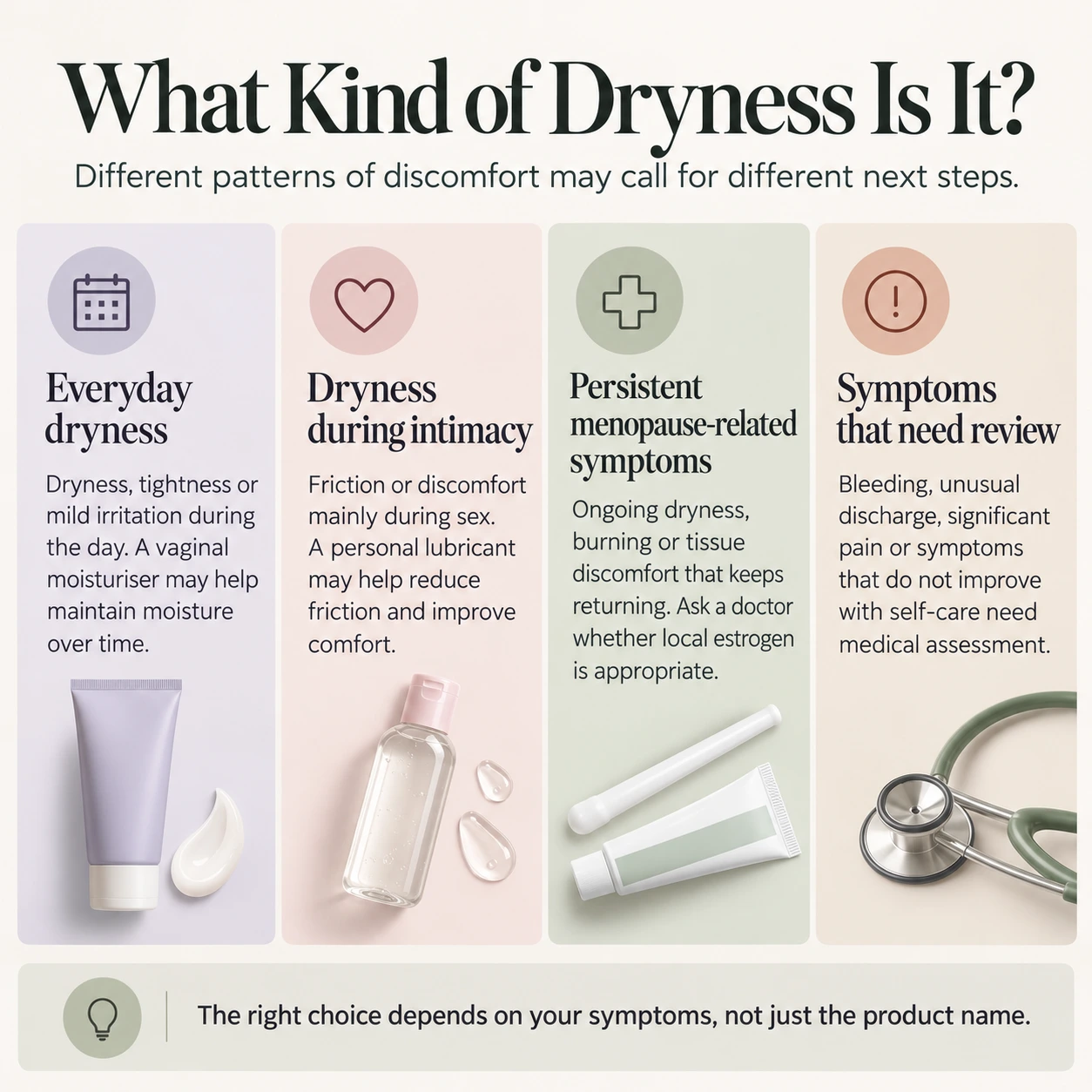
Standard water-based lubricants often dry out quickly and may contain glycerin or propylene glycol that stings sensitive tissues. Switching to a medical-grade silicone lubricant provides a longer-lasting, non-irritating barrier that does not absorb into the skin.
You can also use comfortable silicone depth-limiting rings to customize penetration depth and prevent uncomfortable internal pressure. If muscle tightness persists, a referral to a pelvic floor physical therapist can help retrain those muscles to release and relax.
Vaginal Moisturizers vs. Local Estrogen
A lubricant is designed strictly for use during intimacy, whereas a vaginal moisturizer provides ongoing tissue hydration throughout the week. Over-the-counter hyaluronic acid vaginal moisturizers, used two to three nights per week, help draw water directly into mucosal cells to restore suppleness.
The World Health Organization and sexual health guidelines recommend using products with an osmolality below 1,200 mOsm/kg and a physiological pH near 4.0 to ensure tissues absorb moisture rather than losing it.
When over-the-counter products are not enough, low-dose localized vaginal estrogen remains the clinical gold standard for restoring tissue integrity.
The Role of Localized Vaginal Estrogen
While navigating hormone replacement therapy is often essential for whole-body symptoms like severe hot flashes, localized vaginal estrogen is applied directly where tissue changes occur. It is available as a small tablet, a flexible ring, or a topical cream.
According to clinical guidance from the American College of Obstetricians and Gynecologists (ACOG), localized vaginal estrogen results in minimal systemic absorption, maintaining circulating estrogen levels well within the normal postmenopausal baseline. Because systemic exposure is negligible, localized therapy does not carry the typical whole-body risks associated with systemic hormones.
Randomized clinical trials show that local vaginal estrogen reduces recurrent urinary tract infection rates by over 50% while restoring cellular thickness and lowering vaginal pH back to an acidic range. For women who prefer or require non-hormonal prescription options, daily vaginal prasterone (DHEA) inserts provide a targeted, FDA-approved alternative.
How to Talk to Your Provider
You never need to feel uncomfortable discussing these symptoms with your healthcare provider. In primary care and women’s health settings, these concerns are routine issues that clinicians evaluate and manage every day.
At your next appointment, you can start the discussion with this straightforward script:
“Nurse Alice / Doctor, I have been experiencing persistent vaginal dryness, irritation, and changes in my bladder since menopause. These symptoms are affecting my daily comfort and intimacy, and I would like to review my options for localized vaginal estrogen or a targeted non-hormonal prescription.”
Reclaiming Your Comfort and Quality of Life
Addressing these symptoms is about protecting your comfort, personal relationships, and overall quality of life. When you no longer have to navigate constant burning, irritation, or frequent bladder infections, you regain your daily peace of mind.
Midlife should be a time of vitality, confidence, and physical well-being. Safe, effective clinical treatments are readily available, and you deserve care that addresses your physical health with clarity and respect.
Take this information to your next checkup, have an open conversation with your clinician, and get the relief you need.